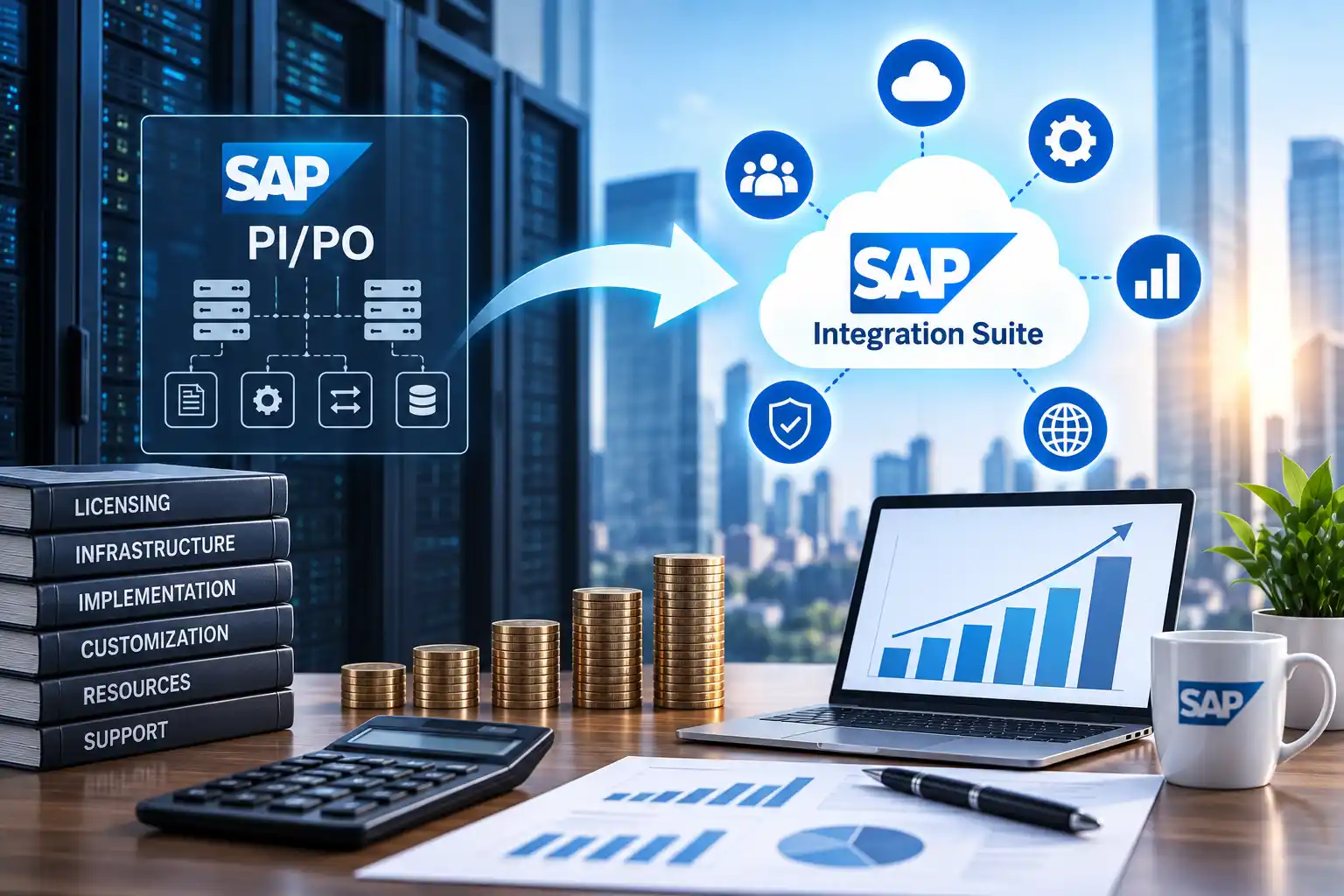
Planning a move from SAP Process Integration (PI) or SAP Process Orchestration (PO) to SAP Integration Suite requires more than estimating the cost of rebuilding interfaces.
The total SAP PI/PO migration cost can include SAP Integration Suite licensing, migration assessment, architecture, interface redevelopment, testing, security and connectivity, project management, training, production cutover, and post-migration support.
For enterprise IT leaders, one of the biggest budgeting mistakes is treating migration as a simple per-interface exercise.
Two organizations can have the same number of PI/PO interfaces and require very different migration budgets because their integration landscapes may differ significantly in complexity, custom development, message volumes, business criticality, and testing requirements.
SAP currently offers multiple SAP Integration Suite editions with different capabilities, message allowances, and pricing structures. SAP’s published pricing page also shows that additional message capacity and other components can affect the overall platform cost.
This guide explains the major components of SAP PI/PO migration cost and how enterprises can build a realistic migration budget.
What Is SAP PI/PO Migration Cost?
SAP PI/PO migration cost is the combined investment required to assess, plan, redesign, migrate, test, deploy, and operate existing SAP PI/PO integrations on SAP Integration Suite.
A complete budget can include:
- SAP Integration Suite licensing
- SAP BTP-related requirements
- Migration assessment
- Architecture and planning
- Interface migration
- Integration flow redesign
- Custom development
- Mapping conversion
- Adapter configuration
- Security configuration
- Connectivity
- Testing
- Performance validation
- Production cutover
- Project management
- Documentation
- Training
- Post-migration support
- Legacy PI/PO decommissioning
The exact combination depends on the organization’s existing landscape and its target architecture.
Does SAP PI/PO Migration Have a Fixed Cost?
No.
There is no single fixed price that applies to every SAP PI/PO migration project.
The final cost depends on several variables, including:
- Number of interfaces
- Complexity of integrations
- Number of connected systems
- Message volumes
- Custom mappings
- Custom code
- Adapter requirements
- B2B requirements
- API requirements
- Security requirements
- Testing scope
- Business-critical processes
- Required migration timeline
- Internal versus external resources
- SAP Integration Suite edition
- Additional platform requirements
SAP’s current pricing model includes different Integration Suite editions and message allowances, so platform licensing itself can vary according to the capabilities and capacity an enterprise needs.
Therefore, an enterprise should develop its budget from an assessment of the actual environment rather than applying a generic price to every interface.
The 7 Main Components of SAP PI/PO Migration Cost
A practical migration budget can be divided into seven major categories.
1. SAP Integration Suite Licensing
The first major cost component is the SAP Integration Suite platform itself.
SAP currently provides different editions with different capabilities.
The published SAP pricing structure includes:
- Starter edition
- Standard edition
- Enhanced edition
The editions differ in areas such as Cloud Integration, API Management, B2B capabilities, Integration Assessment, Open Connectors, event-driven capabilities, and other services.
For example, SAP’s current published pricing page lists the Starter edition with 50,000 messages per month and the Standard edition with 10,000 messages per month as part of their respective packages, while the feature sets differ considerably. Additional messages can also be purchased for applicable editions.
This is important because an enterprise should not select a platform edition purely based on interface count.
Message volume and required capabilities also matter.
What Should IT Leaders Evaluate?
Before estimating licensing requirements, determine:
- Monthly message volume
- Peak message volume
- API requirements
- B2B requirements
- Event-driven integration requirements
- Third-party connectivity
- Integration Assessment requirements
- Number of tenants
- Production and non-production requirements
- Private connectivity requirements
- Additional platform services
The correct SAP Integration Suite subscription should be evaluated against the organization’s actual requirements.
2. SAP PI/PO Migration Assessment Cost
Before beginning full migration, enterprises need to understand what they actually have.
Migration assessment helps determine:
- Which interfaces are migration-ready
- Which interfaces require adjustments
- Which interfaces require further evaluation
- Which integrations may need redesign
- Which interfaces are obsolete
- Which interfaces are business-critical
- Which interfaces have complex dependencies
SAP’s Migration Assessment categorizes scenarios as Ready to Migrate, Adjustment Required, and Evaluation Required. SAP also specifically notes that being categorized as “Ready to Migrate” does not mean the migration is automatically completed by tooling.
This distinction matters for budgeting.
An interface classified as ready to migrate may still require:
- Configuration
- Validation
- Testing
- Security setup
- Connectivity configuration
- Business verification
Therefore, migration assessment should be treated as an important input into the project estimate rather than assuming that assessment results equal final migration effort.
3. Interface Migration and Development Cost
This is often one of the largest components of the project.
Each PI/PO integration needs to be reviewed to determine whether it can be migrated directly, adjusted, redesigned, or replaced.
Migration work may involve:
- Integration flow development
- Mapping conversion
- Routing logic
- Transformation logic
- Adapter configuration
- Exception handling
- Security configuration
- External system connectivity
- Custom scripting
- Logging
- Monitoring
Simple integrations may require relatively limited effort.
Complex integrations can require considerably more work.
For example, a straightforward SAP-to-SAP interface may have fewer migration challenges than an integration involving multiple external systems, custom mappings, custom code, complex routing, and business-specific exception handling.
This is why SAP PI/PO migration cost should not be calculated only by the number of interfaces.
4. Custom Development and Redesign Cost
Existing PI/PO environments often contain custom logic accumulated over many years.
Some integrations may use:
- Custom Java mappings
- User-defined functions
- Adapter modules
- Custom scripts
- Complex message transformations
- Custom routing
- Special error-handling logic
- Legacy integration patterns
These components need to be reviewed during migration.
Some may be replaceable with standard SAP Integration Suite capabilities.
Others may require redesign or redevelopment.
This can significantly influence the final project budget.
A useful budgeting question is:
How much of the existing PI/PO landscape can be migrated as-is, and how much needs redesign?
The answer can have a major impact on project effort.
5. Testing and Quality Assurance Cost
Testing is another major component that enterprises sometimes underestimate.
A migrated integration should not be considered complete simply because the new integration flow deploys successfully.
Testing may include:
Unit Testing
Testing individual integration flows and technical components.
Integration Testing
Testing communication between systems.
End-to-End Testing
Validating the complete business process across multiple systems.
Regression Testing
Confirming that existing business processes continue to work after migration.
Performance Testing
Checking whether the new environment can handle expected message volumes.
Security Testing
Validating authentication, authorization, certificates, credentials, and secure communication.
User Acceptance Testing
Allowing business teams to validate the migrated process.
For business-critical integrations, testing requirements can represent a significant part of the overall migration effort.
6. Project Management and Architecture Cost
Large enterprise migrations require more than integration developers.
The project may require:
- SAP integration architects
- SAP Integration Suite specialists
- SAP PI/PO specialists
- Solution architects
- Security specialists
- Basis or platform teams
- Network specialists
- QA engineers
- Business analysts
- Project managers
- Business process owners
The number of resources required depends on the size and complexity of the migration.
Architecture work is particularly important when the enterprise wants to modernize rather than simply reproduce its existing PI/PO design.
The migration may involve decisions around:
- Cloud Integration
- API Management
- Event-driven architecture
- B2B integration
- Connectivity
- Security
- Monitoring
- Governance
- Integration patterns
SAP positions Integration Suite as a broader integration platform rather than simply a replacement runtime, so the target architecture should be considered as part of the migration budget.
7. Post-Migration Support and PI/PO Decommissioning
Migration cost does not necessarily end when interfaces go live.
Enterprises should budget for a stabilization period after production cutover.
This can include:
- Production monitoring
- Issue resolution
- Performance optimization
- Configuration changes
- Documentation updates
- Knowledge transfer
- Operational support
The organization may also need to decommission the old PI/PO environment after all required integrations have been successfully migrated.
Decommissioning can involve:
- Final interface validation
- Dependency checks
- Data retention requirements
- Infrastructure shutdown
- License considerations
- Operational documentation
These activities should be included in the overall migration program.
SAP Integration Suite Licensing vs Migration Cost
One important distinction is the difference between platform cost and migration project cost.
They are not the same thing.
Platform Cost
This may include:
- SAP Integration Suite subscription
- Message capacity
- Additional tenants
- Additional services
- Related SAP BTP requirements
Migration Cost
This may include:
- Assessment
- Architecture
- Development
- Testing
- Security
- Project management
- Cutover
- Training
- Support
An enterprise could therefore have a relatively straightforward licensing requirement but still face substantial migration effort because of a complex existing PI/PO environment.
Likewise, a large integration landscape does not automatically mean that every interface requires a large redevelopment effort.
How SAP Integration Suite Pricing Works
SAP’s current pricing page states that SAP Integration Suite is offered through different editions and that pricing depends on the selected package and contract. SAP also provides additional message capacity for applicable editions.
SAP currently publishes the following examples for its commercial editions:
| SAP Integration Suite edition | Published monthly price* | Included monthly messages |
| Starter | USD 1,728 | 50,000 |
| Standard | USD 5,339 | 10,000 |
| Enhanced | USD 7,688 | 500,000 |
*These are SAP’s currently published US pricing figures and should not be treated as a universal enterprise quote. Actual pricing depends on market, commercial terms, contract structure, and requirements. SAP’s regional pricing pages can differ.
This table illustrates why licensing should be evaluated separately from implementation cost.
For an enterprise operating in another country, the applicable SAP regional pricing and commercial agreement should be checked before creating a final business case.
What Factors Increase SAP PI/PO Migration Cost?
Several factors can increase project effort.
High Interface Count
More interfaces generally mean more assessment, development, testing, and documentation.
However, interface count alone does not determine the final budget.
Complex Interfaces
Interfaces involving complicated transformations, routing, or business logic may require additional development.
Custom Code
Custom Java mappings, scripts, adapter modules, and other extensions can require redesign or redevelopment.
Multiple Source and Target Systems
Each additional dependency can increase testing and coordination requirements.
B2B Integrations
B2B scenarios may introduce additional requirements around partner management, message standards, acknowledgements, and monitoring.
High Business Criticality
Critical integrations require more extensive testing and controlled cutover procedures.
Tight Migration Deadlines
A compressed migration timeline can require additional resources or parallel workstreams.
Distributed Teams
Large international enterprises may need coordination across multiple countries, business units, vendors, and technical teams.
Legacy Documentation
Poor documentation can increase discovery and reverse-engineering effort.
How to Estimate SAP PI/PO Migration Cost
A practical enterprise estimate can be created using a five-step process.
Step 1: Count and Classify Interfaces
Create an inventory of all active PI/PO interfaces.
Then classify them as:
- Simple
- Medium
- Complex
- Business-critical
- Obsolete
- Requires redesign
Step 2: Perform Migration Assessment
Use available SAP assessment capabilities to understand migration readiness.
SAP’s Migration Assessment provides a consolidated view of how prepared integration scenarios are for migration and classifies scenarios according to the features they use.
Step 3: Estimate Development Effort
Estimate the work required for each migration category.
For example:
| Migration category | Typical work |
| Simple | Configuration, migration, validation |
| Medium | Migration, adjustments, testing |
| Complex | Redesign, development, extensive testing |
| Critical | Migration plus expanded testing and controlled cutover |
| Obsolete | Validation and retirement |
These categories should be customized to the organization’s environment rather than treated as universal pricing bands.
Step 4: Add Non-Development Costs
Include:
- Architecture
- Project management
- Security
- Infrastructure
- Testing
- Training
- Documentation
- Cutover
- Support
Step 5: Add Platform Costs
Finally, add:
- SAP Integration Suite subscription
- Message capacity
- Required tenants
- Additional services
- Related SAP BTP costs
This produces a much more realistic budget model than calculating:
Number of interfaces × arbitrary migration price
Example SAP PI/PO Migration Budget Structure
Instead of publishing a misleading universal migration price, enterprises can structure the budget like this:
| Cost area | What to estimate |
| SAP Integration Suite | Subscription and required edition |
| Migration assessment | Discovery and assessment effort |
| Architecture | Target architecture and migration roadmap |
| Interface migration | Development and configuration |
| Redesign | Complex or obsolete architecture changes |
| Testing | Technical, integration, performance and UAT |
| Security | Certificates, authentication and access |
| Connectivity | Network and system connectivity |
| Project management | Planning, coordination and governance |
| Training | Technical and operational knowledge transfer |
| Cutover | Production migration and rollback planning |
| Stabilization | Post-production support |
| Decommissioning | PI/PO shutdown and cleanup |
This structure gives CIOs and IT managers a better basis for comparing vendor proposals.
Why Interface Count Alone Is a Poor Cost Estimator
Consider two organizations.
Enterprise A
- 200 interfaces
- Mostly simple integrations
- Limited custom development
- Well-documented landscape
- Standard adapters
- Low number of critical processes
Enterprise B
- 200 interfaces
- Extensive custom mappings
- Multiple legacy applications
- Complex B2B integrations
- High transaction volumes
- Several business-critical processes
- Limited documentation
Both organizations have 200 interfaces.
But their migration effort can be substantially different.
Therefore, a credible SAP PI/PO migration cost estimate should consider complexity, dependencies, business criticality, and technical requirements instead of interface count alone.
Can SAP PI/PO Migration Reduce Long-Term Integration Costs?
Potentially, but the financial outcome depends on the enterprise’s architecture, licensing arrangement, operational model, and how the new environment is managed.
Moving to SAP Integration Suite can provide access to cloud-based integration capabilities and broader integration services.
However, enterprises should not assume that moving platforms automatically reduces total integration costs.
A proper business case should compare:
- Current PI/PO operating costs
- Current infrastructure costs
- Existing support costs
- SAP Integration Suite licensing
- Migration project cost
- New operational costs
- Required support resources
- Long-term modernization requirements
The goal should be to understand the total cost of ownership, not just the initial migration invoice.
How Can Enterprises Control SAP PI/PO Migration Cost?
Start With Assessment
Do not begin large-scale redevelopment before understanding the existing environment.
Retire Unused Interfaces
Avoid spending migration resources on integrations that no longer provide business value.
Prioritize Migration Waves
Migrate according to business value, technical complexity, dependencies, and risk.
Reuse Standard Integration Content
SAP provides prebuilt integration content and accelerators that may reduce development effort for applicable scenarios. SAP’s current pricing information notes access to more than 3,400 prebuilt integrations and related content depending on edition and use case.
Standardize Where Possible
Avoid recreating unnecessary custom logic in the new platform.
Automate Testing
Repeatable testing can reduce manual effort and improve consistency across migration waves.
Monitor Message Usage
Message consumption can influence platform costs, so usage should be monitored against the selected SAP Integration Suite package.
SAP specifically provides additional message capacity for applicable editions, making message-volume planning an important part of the platform budget.
What Should Be Included in an SAP PI/PO Migration RFP?
If an enterprise is requesting proposals from SAP integration partners, the RFP should ask vendors to separate costs into clear categories.
A useful RFP structure includes:
Discovery and Assessment
Ask for:
- Landscape discovery
- Interface inventory
- Migration assessment
- Complexity classification
- Dependency analysis
Architecture
Ask for:
- Target architecture
- Integration patterns
- Security architecture
- Connectivity architecture
- Monitoring approach
Migration
Ask for:
- Interface migration
- Redesign
- Custom development
- Mapping conversion
- Adapter configuration
Testing
Ask for:
- Unit testing
- Integration testing
- Regression testing
- Performance testing
- UAT support
Deployment
Ask for:
- Cutover planning
- Production deployment
- Rollback planning
- Hypercare
Commercials
Ask vendors to clearly separate:
- One-time migration cost
- Recurring platform cost
- Support cost
- Optional services
- Change-request rates
This makes vendor proposals easier to compare.
Questions to Ask an SAP PI/PO Migration Partner About Cost
Before selecting a migration partner, enterprise IT leaders should ask:
- How did you calculate the migration estimate?
- How many interfaces were included?
- How were complex interfaces classified?
- Did you include custom mappings and code?
- Is testing included?
- Is performance testing included?
- Is production cutover included?
- Is post-go-live support included?
- Are SAP Integration Suite licensing costs included separately?
- What assumptions could cause the estimate to increase?
- What is excluded from the quoted price?
- How are change requests priced?
- How will unused interfaces be handled?
- How will business-critical integrations be migrated?
- What documentation will be delivered?
These questions can expose hidden assumptions before the project begins.
Frequently Asked Questions About SAP PI/PO Migration Cost
How much does SAP PI/PO migration cost?
There is no universal SAP PI/PO migration price. The total depends on the number and complexity of interfaces, custom development, testing requirements, connected systems, business criticality, SAP Integration Suite licensing, and project scope.
What is the biggest cost in SAP PI/PO migration?
For many enterprise projects, significant costs can come from interface redevelopment, redesign, testing, architecture, and project resources. The actual distribution depends on the existing PI/PO environment.
Is SAP Integration Suite included in SAP PI/PO migration cost?
Not necessarily. SAP Integration Suite licensing or subscription costs should normally be considered separately from the professional services required to migrate the existing interfaces.
Does SAP charge based on the number of interfaces?
SAP Integration Suite pricing is not simply a per-interface migration fee. SAP’s current commercial structure includes editions, message allowances, tenants, and additional capabilities.
Can I estimate migration cost from the number of PI/PO interfaces?
Interface count can be one input, but it should not be the only input. Complexity, custom code, dependencies, message volumes, business criticality, testing, and redesign requirements can significantly change the effort.
Does SAP provide tools for estimating migration effort?
Yes. SAP Integration Suite includes Migration Assessment capabilities that evaluate existing SAP Process Orchestration scenarios and provide migration-readiness information.
Should unused PI/PO interfaces be migrated?
Not automatically. Organizations should first determine whether an interface is still required. Retiring obsolete integrations can reduce unnecessary migration work.
Is SAP PI/PO migration a one-time cost?
The migration project itself is a one-time transformation program, but the target platform introduces ongoing licensing, platform operation, support, monitoring, and maintenance considerations.
Final Thoughts
The right way to approach SAP PI/PO migration cost is to build the estimate from the actual integration landscape.
A reliable enterprise budget should account for:
- SAP Integration Suite licensing
- Migration assessment
- Architecture
- Interface migration
- Redesign
- Custom development
- Security
- Connectivity
- Testing
- Project management
- Cutover
- Training
- Stabilization
- PI/PO decommissioning
The most important budgeting principle is simple:
Do not estimate an SAP PI/PO migration using interface count alone.
Instead, assess the existing landscape, classify migration complexity, identify business-critical integrations, determine the required SAP Integration Suite capabilities, and then build the project estimate around the actual work involved.
SAP’s current Migration Assessment capabilities can help organizations understand migration readiness, while SAP’s current Integration Suite pricing structure provides different editions and usage models that should be evaluated against the enterprise’s requirements.
For CIOs, CTOs, SAP managers, and enterprise architects, this approach provides a more defensible basis for planning the migration budget and evaluating proposals from SAP integration partners.
Related SAP PI/PO Migration Topics
After estimating the budget, the next step is understanding how to select the right migration partner.
Related topics include:
- SAP PI/PO Migration Strategy
- How to Choose an SAP PI/PO Migration Partner
- SAP PI/PO Migration Assessment
- SAP PI/PO End-of-Life Planning
- SAP Integration Partner Selection
- SAP Integration Consulting Services
- SAP Integration Services Outsourcing
- SAP Integration Services Cost
- SAP Integration Project Planning