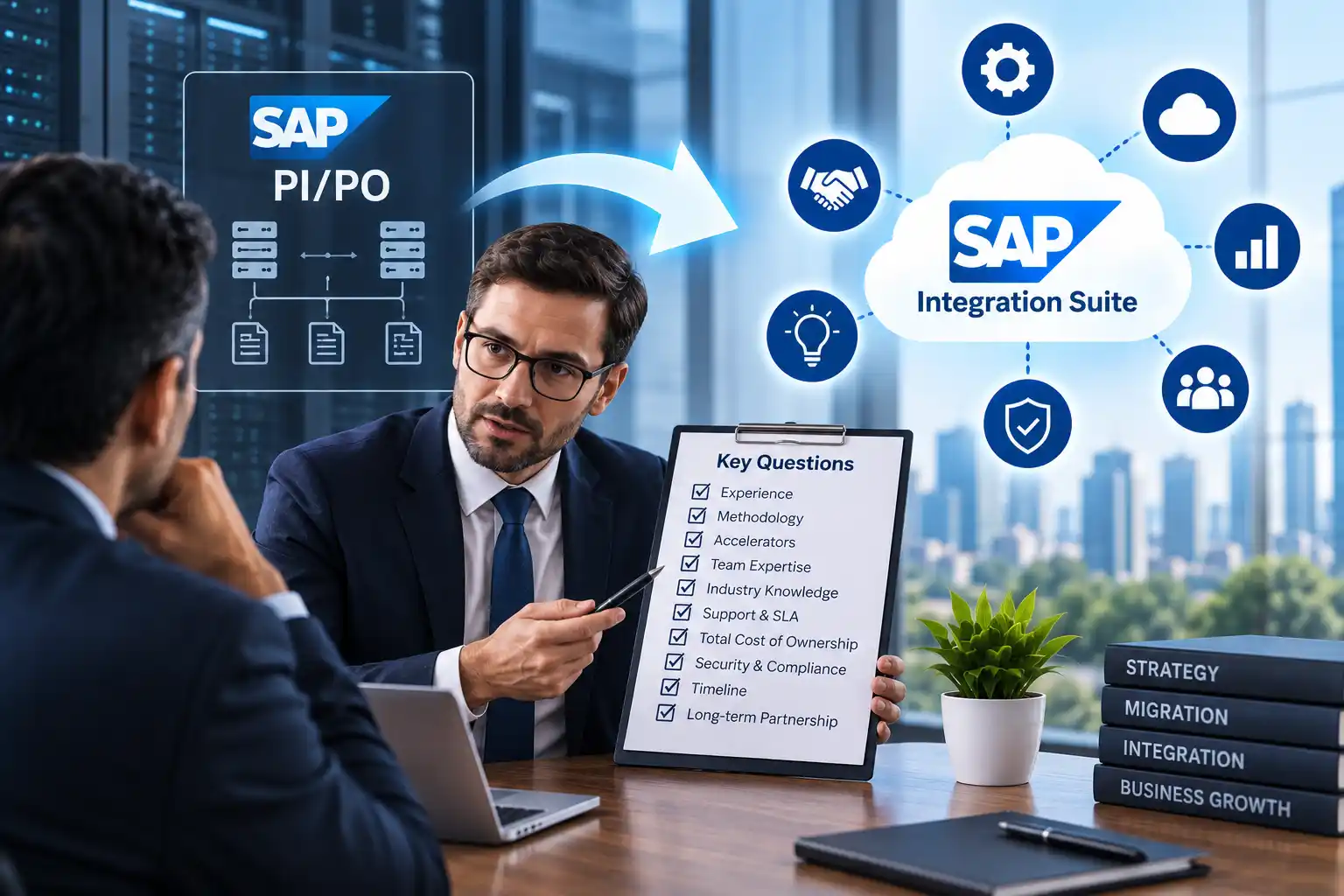
Choosing the right SAP PI/PO migration partner is an important decision for enterprises planning a move to SAP Integration Suite.
The migration is not simply a matter of moving interfaces from one platform to another. Existing integrations may contain custom mappings, complex routing, legacy adapters, business-critical processes, B2B scenarios, security dependencies, and integrations with both SAP and non-SAP applications.
A migration partner therefore needs to understand more than SAP PI/PO technology.
The partner should be able to assess the existing landscape, develop a migration strategy, define the target architecture, identify technical risks, execute migration waves, support testing, and help the organization manage production cutover.
SAP’s current migration guidance describes a structured process that begins with discovering the existing interfaces and integration requirements, defining the target architecture, preparing the migration strategy, and then moving and validating the integrations.
SAP also currently describes its partner ecosystem as part of the available support for organizations moving from SAP Process Orchestration to SAP Integration Suite.
This guide explains 10 questions enterprise IT leaders should ask before selecting an SAP PI/PO migration partner.
Why Does the Choice of SAP PI/PO Migration Partner Matter?
An SAP PI/PO environment can become deeply connected to an organization’s business processes over time.
An enterprise may depend on PI/PO for:
- SAP-to-SAP integrations
- SAP-to-third-party integrations
- Customer integrations
- Supplier integrations
- Banking integrations
- Manufacturing processes
- Procurement
- Order management
- Finance
- Logistics
- Human resources
- B2B communication
- API-based integration
A migration partner that focuses only on technical conversion may overlook the business dependencies surrounding these interfaces.
The right partner evaluation should therefore cover four areas:
Technical Capability
Can the partner handle PI/PO and SAP Integration Suite migration requirements?
Architecture Capability
Can the partner determine how the target integration landscape should be designed?
Delivery Capability
Can the partner manage migration, testing, cutover, and stabilization?
Business Understanding
Can the partner understand the business processes affected by the integrations?
These areas should be evaluated before comparing commercial proposals.
10 Questions to Ask an SAP PI/PO Migration Partner
1. How Will You Assess Our Existing PI/PO Landscape?
This should be one of the first questions asked.
Before migration begins, the partner should explain how it will understand the existing environment.
The assessment should consider areas such as:
- Number of interfaces
- Integration scenarios
- Source systems
- Target systems
- Adapters
- Message mappings
- Custom code
- Dependencies
- Message volumes
- Business-critical processes
- B2B integrations
- Security requirements
- Existing monitoring
- Existing documentation
SAP’s migration guidance specifically starts with discovering and assessing the current interfaces and integration requirements before defining the target architecture.
What Should the Assessment Deliver?
Ask the partner:
“What exactly will you deliver at the end of the assessment?”
A useful assessment should produce more than an interface count.
It should help the enterprise understand:
- What can be migrated
- What needs adjustment
- What requires redesign
- What may need further technical evaluation
- What should potentially be retired
- What should be migrated first
SAP’s Migration Assessment classifies scenarios into categories including Ready to Migrate, Adjustment Required, and Evaluation Required. SAP also notes that a scenario being classified as ready to migrate does not mean no further manual adaptation or configuration is required.
2. What SAP PI/PO to SAP Integration Suite Migration Methodology Do You Follow?
Do not accept a proposal that only says:
“We will migrate your interfaces to SAP Integration Suite.”
Ask the partner to explain its complete methodology.
A structured methodology may include:
- Discovery
- Assessment
- Architecture
- Migration planning
- Pilot migration
- Migration waves
- Testing
- Production cutover
- Stabilization
- Documentation and knowledge transfer
SAP’s own migration guidance describes Discover and Prepare phases before the migration activities, including assessing existing interfaces, identifying target architecture, and defining the migration strategy.
What Are the Expected Deliverables?
The partner should be able to explain what happens during each phase.
Ask:
“What are the deliverables at every stage?”
This makes it easier to distinguish between a structured migration program and a proposal based primarily on development hours.
3. How Will You Determine Which Interfaces Should Be Migrated First?
A good migration partner should not recommend migrating interfaces purely according to their order in the PI/PO system.
Migration sequencing should consider factors such as:
- Technical complexity
- Business criticality
- Dependencies
- Message volume
- Testing effort
- Custom development
- System availability
- Business impact
- Integration patterns
A simple interface that supports a critical business process may require more planning than a complex interface used only for a low-priority process.
SAP has also published migration guidance recommending an approach that starts with assessment and planning before moving and validating integrations.
How Should Migration Waves Be Created?
Ask the partner:
“How will you create the migration waves, and what criteria will you use?”
The answer should demonstrate that migration sequencing is based on both technical and business considerations.
4. How Much SAP Integration Suite Experience Does Your Team Have?
This question goes beyond asking whether the company is an SAP partner.
Ask about the actual people who will work on the project.
Questions to Ask About the Project Team
- How many SAP Integration Suite migrations has the team completed?
- How much PI/PO experience does the team have?
- Who will be the solution architect?
- Who will perform the integration development?
- Does the team understand Cloud Integration?
- Does the team understand API Management?
- Can the team handle B2B scenarios?
- Does the team understand hybrid connectivity?
- Does the team have experience with complex mappings?
- Who will handle testing?
- Who will support production cutover?
Experience should be evaluated at the project-team level, not only at the company level.
A company may have broad SAP capabilities while the proposed project team has limited experience with the specific migration scenario.
5. Can You Handle Complex and Custom PI/PO Integrations?
This is particularly important for older PI/PO environments.
Some organizations have accumulated custom development over many years.
Examples of Custom PI/PO Components
- Custom Java mappings
- User-defined functions
- Adapter modules
- Custom scripts
- Complex transformations
- Special routing logic
- Custom error handling
- Legacy adapters
- B2B mappings
Ask the partner:
“How will you identify and handle custom PI/PO functionality?”
A credible migration assessment should identify these components before the enterprise commits to a final migration timeline.
SAP’s Migration Assessment distinguishes between scenarios based on their compatibility with SAP Integration Suite, including scenarios that require adjustment or further evaluation.
This is particularly important because an automated or semi-automated migration does not eliminate the need for technical review.
6. How Will You Design the Target Integration Architecture?
A migration should not automatically reproduce the old architecture.
The partner should be able to explain how it will determine the appropriate target architecture in SAP Integration Suite.
Areas to Evaluate in the Target Architecture
- Cloud Integration
- API Management
- Event-driven integration
- B2B capabilities
- Connectivity
- Integration patterns
- Security
- Monitoring
- Governance
- Hybrid integration requirements
SAP’s Integration Solution Advisory Methodology provides a structured approach for defining an enterprise integration strategy. It begins with technology-agnostic integration requirements and then maps those requirements to appropriate integration technologies.
Modernization vs. Recreating the Existing Architecture
Ask:
“Will you simply recreate our PI/PO architecture, or will you evaluate whether the existing architecture should be modernized?”
This question can reveal how the partner approaches modernization.
7. What Testing Strategy Will You Use?
Testing can become one of the largest parts of a migration project.
Ask the partner to explain how testing will be handled.
Unit Testing
Testing individual integration flows.
Integration Testing
Testing communication between source and target systems.
End-to-End Testing
Testing the complete business process.
Regression Testing
Ensuring existing processes continue to operate correctly.
Performance Testing
Testing expected and peak message volumes.
Security Testing
Validating authentication, authorization, certificates, and secure connectivity.
User Acceptance Testing
Having business teams validate the migrated process.
Ask:
“Who is responsible for creating test cases, executing tests, documenting results, and fixing defects?”
The answer should be explicitly included in the project scope.
SAP’s current migration ecosystem also includes tools and services intended to support migration assessment and migration activities, while partner tooling can support areas such as testing.
8. How Will You Minimize Business Disruption During Cutover?
This is one of the most important questions for business-critical environments.
Cutover Planning Should Address
- Cutover methodology
- Downtime requirements
- Interface freeze requirements
- Data synchronization
- Production validation
- Monitoring
- Rollback procedures
- Incident escalation
- Business communication
SAP’s current migration program emphasizes maintaining continuity for business-critical processes while organizations modernize their integration landscape.
The partner should be able to provide a specific cutover strategy rather than simply saying that downtime will be minimal.
What Happens If a Critical Integration Fails?
Ask:
“If a critical integration fails after production cutover, what is the rollback process?”
The answer should be documented before the production migration.
9. What Exactly Is Included in Your Migration Proposal?
Two SAP migration proposals can have very different scopes even when they appear to offer the same service.
Assessment
- Discovery
- Interface inventory
- Migration assessment
- Complexity classification
Architecture
- Target architecture
- Integration patterns
- Security
- Connectivity
- Governance
Development
- Integration flow migration
- Mapping
- Adapter configuration
- Custom development
- Redesign
Testing
- Unit testing
- Integration testing
- Regression testing
- Performance testing
- UAT support
Deployment
- Cutover planning
- Production deployment
- Rollback planning
- Hypercare
Documentation
- Technical documentation
- Architecture documentation
- Operational documentation
- Knowledge transfer
Support
- Post-go-live support
- Defect resolution
- Stabilization
Then ask:
“What is explicitly excluded from the proposal?”
This question is just as important as asking what is included.
10. How Will You Estimate and Control the Total Migration Cost?
The final question should focus on commercial transparency.
The partner should explain how the estimate was calculated.
Factors That May Influence Migration Cost
- Interface count
- Complexity
- Development effort
- Testing effort
- Architecture effort
- Project duration
- Resource requirements
- Migration waves
- Custom development
- Business-critical interfaces
Commercial Questions to Ask
- What assumptions were made?
- What could increase the price?
- What is the change-request process?
- Are testing costs included?
- Is post-go-live support included?
- Are SAP licenses included or separate?
- Are third-party tools included?
- Are travel expenses included?
- What happens if additional interfaces are discovered?
This is especially important because SAP Integration Suite licensing and professional migration services are separate considerations when developing the overall migration business case.
SAP PI/PO Migration Partner Evaluation Checklist
Before selecting a partner, enterprise IT leaders can use the following checklist.
Technical Experience
- PI/PO experience
- SAP Integration Suite experience
- Cloud Integration experience
- API Management experience
- B2B integration experience
- Complex mapping experience
- Custom-code migration experience
- Hybrid connectivity experience
Assessment
- Existing landscape discovery
- Interface inventory
- Dependency analysis
- Migration readiness assessment
- Complexity classification
- Business-criticality assessment
Architecture
- Target architecture
- Integration patterns
- Security design
- Connectivity design
- Monitoring strategy
- Governance
Delivery
- Pilot migration
- Migration waves
- Testing
- Cutover
- Rollback
- Hypercare
- Documentation
- Knowledge transfer
Commercial
- Detailed scope
- Clear assumptions
- Clear exclusions
- Licensing separated from services
- Change-request process
- Post-go-live support defined
What Should an SAP PI/PO Migration Partner Deliver?
Before signing a contract, ask for a clear list of project deliverables.
Current-State Assessment
Documentation of the existing PI/PO landscape.
Migration Assessment
Classification of integration scenarios and identification of potential migration challenges.
Target Architecture
Definition of the future SAP Integration Suite architecture.
Migration Roadmap
Prioritized migration waves with dependencies and timelines.
Pilot Migration
Migration of selected interfaces to validate the approach.
Production Migration
Execution of approved migration waves.
Testing Documentation
Test cases, results, defect tracking, and business validation.
Cutover Plan
Detailed production migration and rollback procedures.
Technical Documentation
Documentation of the migrated integration landscape.
Knowledge Transfer
Training and handover for the internal SAP integration team.
Post-Go-Live Support
Stabilization and issue resolution following production migration.
The exact deliverables should be agreed upon before the project starts.
SAP Partner vs SAP Services vs Independent Migration Specialist
Enterprises may encounter different types of migration providers.
- SAP services
- SAP partners
- Specialized SAP integration consultancies
- Independent migration specialists
- Technology vendors providing migration tools
SAP itself currently describes SAP Services and Support, migration tools and services, and a partner ecosystem as available paths for organizations moving from SAP Process Orchestration to SAP Integration Suite.
The important point is to evaluate the actual scope and capabilities being offered.
Key Evaluation Areas
- Technical expertise
- Relevant migration experience
- Team structure
- Methodology
- Tools
- Testing approach
- Architecture capability
- Commercial model
- Support model
rather than selecting a provider based only on its company category.
Should You Choose a Partner Based on the Lowest Migration Quote?
Price is one part of the commercial evaluation, but a migration proposal should be understood in terms of scope, assumptions, resources, and deliverables.
A lower initial estimate may reflect:
- Fewer testing activities
- Limited architecture work
- Fewer included migration scenarios
- Excluded post-go-live support
- Assumptions about interface complexity
- Separate change-request charges
- Limited documentation
A higher estimate may include additional activities.
Therefore, enterprise procurement teams should compare proposals on a like-for-like scope basis.
What Should Be Clearly Identified in Every Proposal?
- Included
- Excluded
- Assumptions
- Optional services
- Change-request rates
This makes commercial comparison more meaningful.
Red Flags When Selecting an SAP PI/PO Migration Partner
Promises to Migrate Everything Automatically
Migration tooling can accelerate parts of the process, but SAP documentation makes clear that migrated scenarios can still require manual adaptation or configuration.
Does Not Request Access to the Existing Landscape
A credible estimate generally requires an understanding of what actually exists.
Focuses Only on Interface Count
Interface count does not fully describe migration complexity.
Has No Testing Strategy
Testing should be explicitly planned.
Has No Rollback Plan
Critical production integrations require a defined recovery approach.
Does Not Discuss Custom Code
Custom logic can materially affect migration effort.
Cannot Explain the Target Architecture
Migration should be connected to the organization’s future integration strategy.
Provides a Quote Without Assumptions
Every estimate should have clearly documented assumptions and exclusions.
How Long Does It Take to Select an SAP PI/PO Migration Partner?
The selection timeline depends on the enterprise’s procurement process and the complexity of the environment.
Step 1: Define Requirements
Document the current environment and business objectives.
Step 2: Shortlist Providers
Identify partners with relevant PI/PO and SAP Integration Suite experience.
Step 3: Technical Assessment
Ask shortlisted providers to explain their migration methodology.
Step 4: Proposal
Request detailed scope, assumptions, resources, timeline, and pricing.
Step 5: Technical Workshop
Review the current landscape and target architecture with the proposed team.
Step 6: Commercial Evaluation
Compare proposals using the same scope.
Step 7: Contract and Project Planning
Finalize responsibilities, deliverables, governance, and migration milestones.
This process helps prevent the partner selection decision from becoming purely price-driven.
Frequently Asked Questions About SAP PI/PO Migration Partners
What does an SAP PI/PO migration partner do?
An SAP PI/PO migration partner can support activities such as landscape assessment, migration planning, target architecture, interface migration, testing, production cutover, documentation, and post-go-live support.
What should I look for in an SAP PI/PO migration partner?
Look for relevant PI/PO and SAP Integration Suite experience, a structured migration methodology, architecture capability, testing expertise, experience with complex integrations, transparent commercial terms, and a clear cutover and support strategy.
Can SAP PI/PO migration be automated?
Parts of the migration can be supported by SAP’s migration tooling and partner tools, but automation does not eliminate the need for assessment, manual adaptations, testing, configuration, and validation. SAP specifically notes that migration-ready scenarios can still require manual adaptations or configuration.
Should an SAP migration partner also handle SAP Integration Suite architecture?
For larger enterprise migrations, architecture should be explicitly addressed. SAP’s Integration Solution Advisory Methodology provides a structured approach for defining integration strategy and mapping requirements to appropriate technologies.
How do I compare SAP PI/PO migration partners?
Request comparable information from each provider covering methodology, experience, assessment, architecture, migration scope, testing, cutover, resources, assumptions, exclusions, pricing, and post-go-live support.
Should the migration partner perform a PI/PO assessment before giving a final quote?
For complex environments, a detailed assessment can provide a more reliable basis for estimating migration effort. SAP provides Migration Assessment capabilities specifically to evaluate existing integration scenarios and their migration situation.
Final Thoughts
Choosing an SAP PI/PO migration partner is not simply about finding a company that can develop SAP Integration Suite interfaces.
The partner should be capable of understanding the existing integration landscape, identifying migration risks, designing the target architecture, managing migration waves, testing business-critical processes, and supporting production cutover.
Before signing a migration contract, enterprise IT leaders should ask:
- How will you assess our existing PI/PO landscape?
- What migration methodology do you follow?
- How will you prioritize migration waves?
- What SAP Integration Suite experience does your team have?
- Can you handle complex and customized PI/PO scenarios?
- How will you design our target architecture?
- What is your testing strategy?
- How will you minimize business disruption?
- What exactly is included and excluded from the proposal?
- How will you estimate and control the total migration cost?
These questions give CIOs, CTOs, SAP managers, and enterprise architects a structured framework for evaluating potential migration providers.
SAP’s current migration guidance supports a structured journey covering discovery, preparation, migration, and validation, while SAP also provides Migration Assessment capabilities and a partner ecosystem to support organizations during the transition.
The most important step is to understand the existing environment before committing to a migration scope. Once the landscape, dependencies, complexity, and business priorities are clear, an enterprise can make a more informed decision about the migration approach, partner responsibilities, timeline, and budget.
Related SAP PI/PO Migration Topics
- SAP PI/PO Migration Strategy: How can enterprises move to SAP Integration Suite without business disruption?
- SAP PI/PO Migration Cost: What should enterprises budget for the migration?
- SAP PI/PO Migration Assessment: What should IT leaders evaluate before starting?
- SAP PI/PO End-of-Life Planning: What should enterprises do before PI/PO maintenance deadlines?
- SAP Integration Partner Selection: How should global enterprises evaluate an SAP integration partner?
- SAP Integration Consulting Services: What should enterprises expect from a strategic integration partner?
- SAP Integration Services Outsourcing: When should an enterprise outsource integration work?
- SAP Integration Services Cost: What factors affect the cost of SAP integration services?
- SAP Integration Project Planning: How should enterprises estimate scope, timeline, risk, and cost?