Listing summary: SAP is retiring the Neo environment on 31 December 2028. Learn what it means for Cloud Integration tenants and how to plan the move to Cloud Foundry.
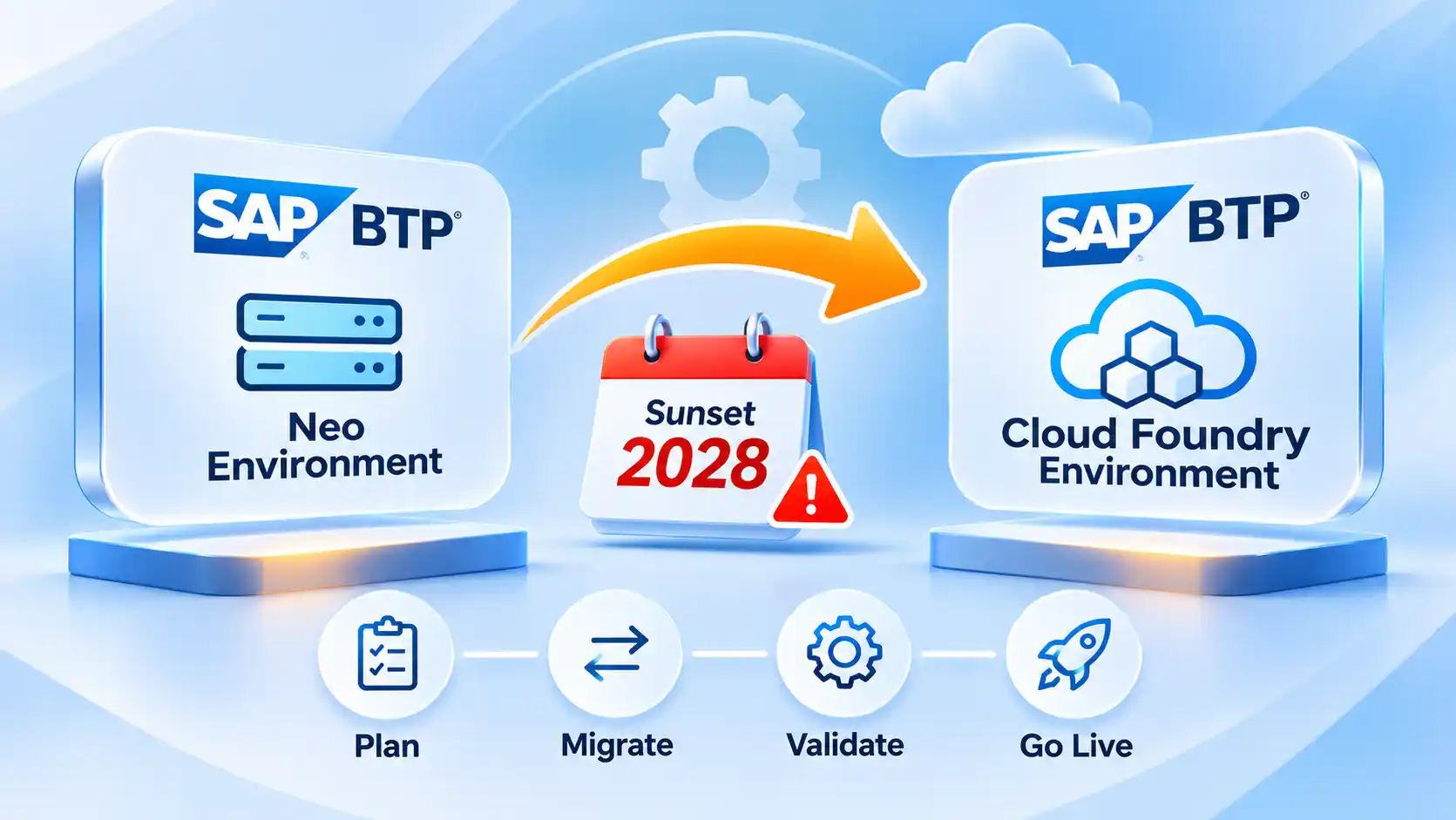
If your integration tenant was created several years ago, it may still run on SAP’s Neo environment. SAP has announced that Neo will be sunset on 31 December 2028, and the move to the multi-cloud foundation is not automatic. Two years sounds generous until you count interfaces, partner approvals and change freezes. This guide helps integration teams start early and finish calmly.
Quick Answer
SAP BTP’s Neo environment is scheduled for retirement on 31 December 2028. Cloud Integration tenants running on Neo must be migrated to Cloud Foundry tenants, and the customer or a partner must manage that migration. A good plan covers inventory, a new tenant, content migration, connectivity changes, testing and a controlled cutover for each interface group.
What Is Changing?
Neo is SAP’s older, proprietary platform environment. Cloud Foundry is part of SAP’s multi-cloud foundation, which runs on the major hyperscalers and is the default environment for new customers. For integration teams, this means that tenants of SAP Integration Suite and Cloud Integration on Neo need a counterpart on Cloud Foundry, and the interfaces need to move across.
It also affects more than your own interfaces. SAP-delivered content for other products, and managed integration services connected to SAP Business Network, have their own Neo to Cloud Foundry migration notices. If your landscape depends on them, watch for the instructions from each product team.
What Typically Changes When You Move
Moving from Neo to Cloud Foundry involves more than transferring integration flows. Review the following areas before planning your migration.
| Area | What to Check |
|---|---|
| Tenant URLs and endpoints | Every sender and receiver that calls your flows needs the new address. |
| IP addresses and firewall rules | Partners may need to allow new addresses before cutover. |
| SAP Cloud Connector | Register new Cloud Foundry subaccounts early and keep the old ones until you finish. |
| Security material | Keystores, certificates, OAuth clients and user credentials must be recreated or moved with care. |
| Roles and authorisations | Role models differ between environments. |
| Adapters and features | Confirm each adapter you use is available and behaves the same. |
| Monitoring and alerting | Dashboards and notification rules usually need to be rebuilt. |
| Transport and DevOps | Pipelines point to the old tenant and must be repointed. |
The Migration Journey in Six Steps
1. Inventory and Assess
List every integration package, flow, script, mapping, value map, certificate, credential, data store and variable. Mark what is active, what is idle and what is obsolete. Many tenants carry flows nobody has run for years. Migrating them wastes budget.
2. Prepare the Target
Provision the Cloud Foundry subaccount and tenant, set up roles, and connect the Cloud Connector. Do this early, because partner firewall changes can take weeks to approve.
3. Migrate Content
SAP provides a migration approach for moving integration artefacts, and manual export and import remains an option. Use tooling for volume, but expect to review each flow, because secrets and some configuration do not travel automatically.
4. Test Thoroughly
Replay representative messages through both tenants and compare results. Include error cases, large payloads and scheduled flows.
5. Cut Over in Waves
Group interfaces by business owner and risk. Move low-risk groups first, learn from them, then move the critical ones in change windows the business agrees to.
6. Decommission
Keep the Neo tenant available for rollback until a full business cycle has passed, including month-end. Then retire it and remove stale credentials and network rules.
A Timeline You Can Adapt
Work backwards from 31 December 2028, and leave a buffer for the unexpected.
Now to Mid-2027
Inventory, clean-up, target tenant, connectivity requests.
Mid-2027 to Early 2028
Pilot wave, tooling and test automation proven.
Early to Late 2028
Production waves by business area.
Final Quarter of 2028
Buffer, decommissioning and documentation. Do not plan to use it for real work.
If you also run SAP PI/PO and plan to move it to Integration Suite, combine the two efforts. Building new content straight on Cloud Foundry avoids migrating the same interface twice.
Risks and How to Reduce Them
Hidden Dependencies
A partner hard-coded your old URL. Mitigation: publish the new endpoint early and monitor traffic on the old one.
Credential Sprawl
Secrets created over many years are poorly documented. Mitigation: treat migration as a chance to rotate and consolidate.
Change Freezes
Year-end and quarter-end windows shrink your calendar. Mitigation: agree cutover dates with the business at the start.
Team Capacity
The same people run daily operations. Mitigation: ring-fence time or bring in a partner.
Undocumented Custom Scripts
Review all Groovy and JavaScript steps during assessment.
Budgeting: What Drives Effort?
The cost depends on the number of active interfaces, the share that are complex, the number of external partners affected, and the amount of testing the business requires. Interfaces with heavy scripting, many receivers or strict compliance needs take longer. A short assessment that counts and classifies your interfaces gives a more reliable estimate than any rule of thumb.
Common Mistakes
- Waiting until 2028 because the date feels distant.
- Migrating everything, including unused flows.
- Forgetting the Cloud Connector and partner firewall changes until the week before cutover.
- Not planning rollback.
- Treating the move as a pure lift and shift, and missing the chance to improve naming, security and monitoring.
Frequently Asked Questions
When Does SAP Retire the Neo Environment?
SAP has announced a sunset date of 31 December 2028.
Is the Migration Automatic?
No. Customers, or their partners, must plan and carry it out.
Do We Have to Migrate Every Flow?
No. Retire what is unused and migrate what the business needs.
Will Our Interface URLs Change?
Yes, because the new tenant has a different address. Plan communication to every sender and receiver.
Can We Combine This with a PI/PO Migration?
Yes, and it is usually smart to. Build new content on Cloud Foundry from the start.
How Do We Know If We Are on Neo?
Check your tenant and subaccount details in SAP BTP cockpit, or ask your integration administrator.
Talk to Technolize
Technolize helps enterprises assess, plan and execute SAP Integration Suite migrations. Book a migration assessment and we will inventory your tenant, size the effort and give you a wave-based plan.