
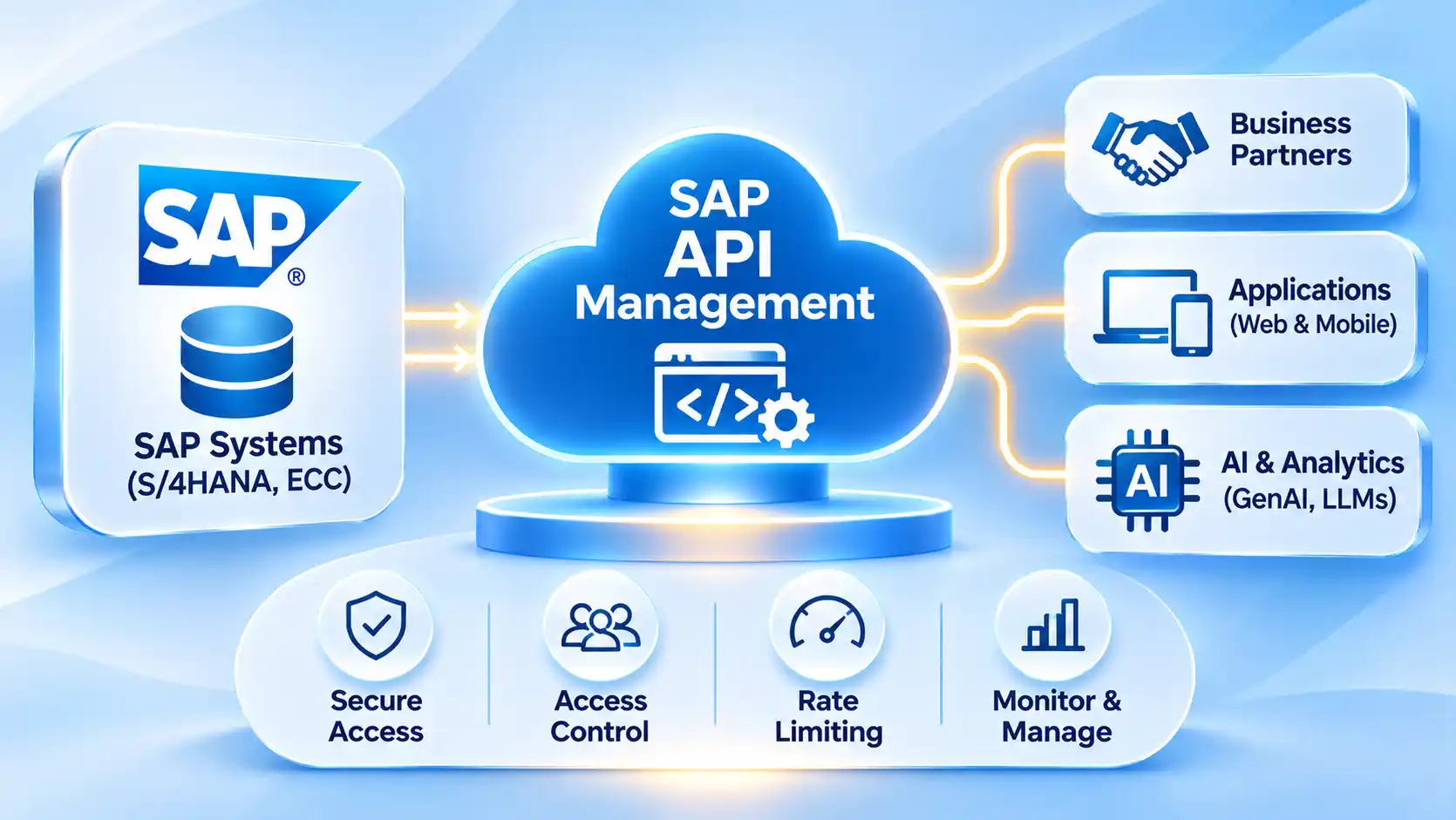
Listing summary: What API management adds to an SAP landscape: security, throttling, versioning and developer onboarding, plus a practical governance model for enterprises.
Sooner or later every enterprise is asked the same question: can our mobile app, our distributor portal or our new AI assistant read data from SAP? Saying yes is easy. Saying yes safely, at scale and without letting one careless app slow down finance is the hard part. API management is the discipline that makes the second answer possible.
Quick Answer
API management places a managed layer between SAP and everything that consumes its data. Instead of giving each consumer direct access to SAP, you publish governed APIs that enforce authentication, rate limits, data filtering and logging, and you let developers discover and subscribe to them. SAP Integration Suite includes an API management capability for this, and it works naturally with integration flows behind it.
Why Direct Access to SAP Is Risky
When consumers connect straight to SAP services, several problems appear over time.
Security Sprawl
Every application gets its own credentials, and nobody can say who uses what.
Performance Risk
A poorly written client can flood SAP with calls during business hours.
Tight Coupling
When SAP is upgraded or a field changes, every consumer breaks at once.
Over-Exposure
A service built for one purpose returns far more data than a partner needs.
No Visibility
Without central logging, you cannot see usage, errors or abuse.
An API layer solves these by putting a controlled front door on your landscape.
What an API Management Layer Provides
An API management platform provides capabilities that help enterprises secure, control and monitor access to SAP data.
| Capability | What It Does | Business Value |
|---|---|---|
| Authentication and authorisation | Verifies who is calling and what they may do. | Stops unauthorised access. |
| Rate limiting and quotas | Caps calls per consumer and time window. | Protects SAP performance. |
| Request and response transformation | Reshapes payloads, hides fields. | Exposes only what is needed. |
| Caching | Serves repeated requests without hitting SAP. | Faster responses, lower load. |
| Versioning | Runs several versions side by side. | Upgrades without breaking consumers. |
| Analytics and logging | Shows usage, latency and errors. | Capacity planning and audit. |
| Developer portal | Lets developers find, test and subscribe to APIs. | Faster onboarding, fewer tickets. |
| Monetisation or chargeback | Meters usage for internal or external billing. | Funds the platform. |
Typical Use Cases of SAP API Management
Partner and Distributor Portals
Give dealers a live view of order status and stock without opening SAP to the internet.
Mobile and Web Applications
Serve front-end teams with stable, well-documented endpoints.
Customer and Supplier Self-Service
Expose invoice status or delivery tracking.
Internal Innovation
Let teams build new tools on approved APIs instead of shadow integrations.
AI Assistants and Agents
Give automated tools narrowly scoped, audited access to business data. Because an agent can call an API very frequently and in unexpected ways, quotas and fine-grained permissions matter even more here.
API-Led Design: Three Layers
A useful way to organise APIs is in three layers.
1. System APIs
System APIs wrap individual back ends such as SAP S/4HANA, SuccessFactors or a warehouse system. They hide technical complexity.
2. Process APIs
Process APIs combine system APIs to deliver a business capability, such as “create order with credit check and stock reservation”. Integration flows often implement these.
3. Experience APIs
Experience APIs shape the result for a specific audience such as a mobile app or a partner.
Why Use a Three-Layer API Architecture?
The layers prevent a front-end change from rippling into SAP, and they let you reuse the same system APIs across many products.
API Governance: The Part Most Projects Skip
Technology is the easy half. Without governance, an API platform becomes another place where unmanaged interfaces accumulate. Agree on the following.
Ownership
Every API has a named owner responsible for quality and lifecycle.
Standards
Naming, error formats, pagination, versioning and documentation follow one guide.
Security Tiers
Public, partner and internal APIs get different controls.
Review
New APIs pass a light design review before publication.
Lifecycle
Define how an API is deprecated, with notice periods for consumers.
Metrics
Track adoption, error rates and response times for each API.
Security Essentials for SAP APIs
- Use modern token-based authentication, not shared passwords.
- Apply the principle of least privilege to every consumer.
- Validate input to block malformed or malicious payloads.
- Mask or remove sensitive fields that a consumer does not need.
- Encrypt traffic and manage certificates centrally.
- Log access in a way that supports investigations.
Protecting SAP from Excessive API Traffic
Apply rate limits, quotas and caching policies to prevent individual applications or external consumers from overwhelming SAP back-end systems.
A Phased Approach to Implementing API Management
- Discover: Inventory the services and interfaces that already expose SAP data.
- Prioritise: Pick the three consumers that create the most risk or the most value.
- Publish: Build and document the first managed APIs with policies applied.
- Onboard: Open the developer portal and move early adopters.
- Retire direct access: Gradually close the unmanaged routes.
- Scale: Add governance reviews and analytics reporting.
Common Mistakes in SAP API Management
- Publishing APIs that mirror SAP tables, so consumers must understand SAP internals.
- Skipping documentation. An undocumented API is an unused API.
- Setting no quotas, then finding out during a campaign launch.
- Never retiring old versions.
- Treating the platform as an IT project with no product owner.
Frequently Asked Questions
What Is the Difference Between API Management and Integration?
Integration moves and transforms data between systems. API management governs how consumers access services: security, limits, publishing and analytics. They work best together.
Do We Need API Management If We Already Use OData Services from SAP?
OData services are a good foundation. API management adds central security, throttling, monitoring and a catalogue on top.
Can We Expose SAP ECC Data Through Managed APIs?
Yes. The managed layer can sit in front of ECC services or integration flows that wrap them.
How Do We Keep External Developers from Overloading SAP?
Use quotas, spike arrest and caching at the API layer.
Can API Management Help with AI Agents?
Yes. It lets you grant narrow, logged access and revoke it quickly.
How Long Does It Take to Launch a First Managed API?
A focused first release often takes four to eight weeks, including policy design and documentation.
Talk to Technolize
Technolize helps enterprises design and operate API layers on SAP Integration Suite. Book a consultation and we will review how your SAP data is exposed today and propose a safer, more scalable model.